
TECH TALK
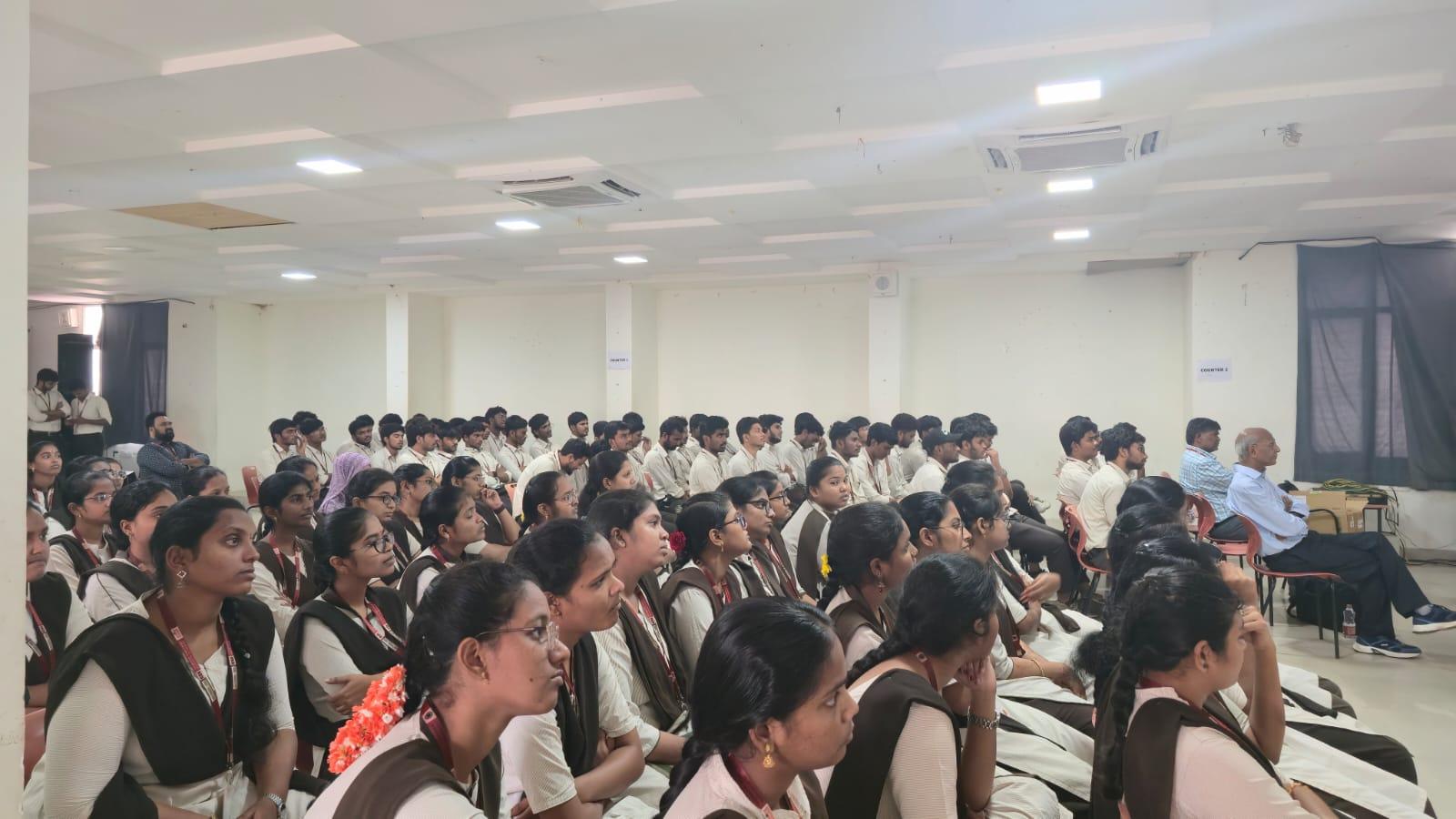
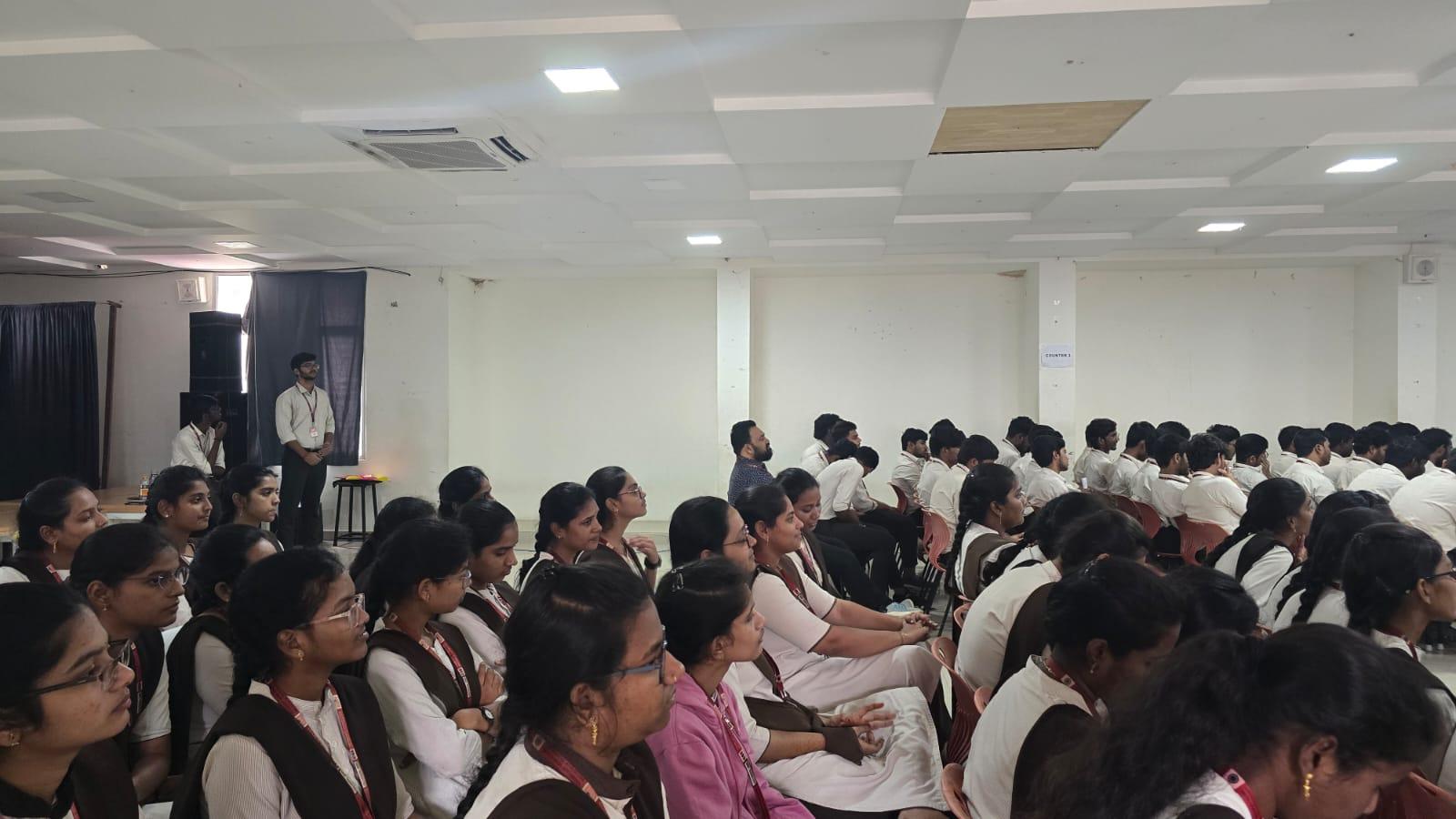
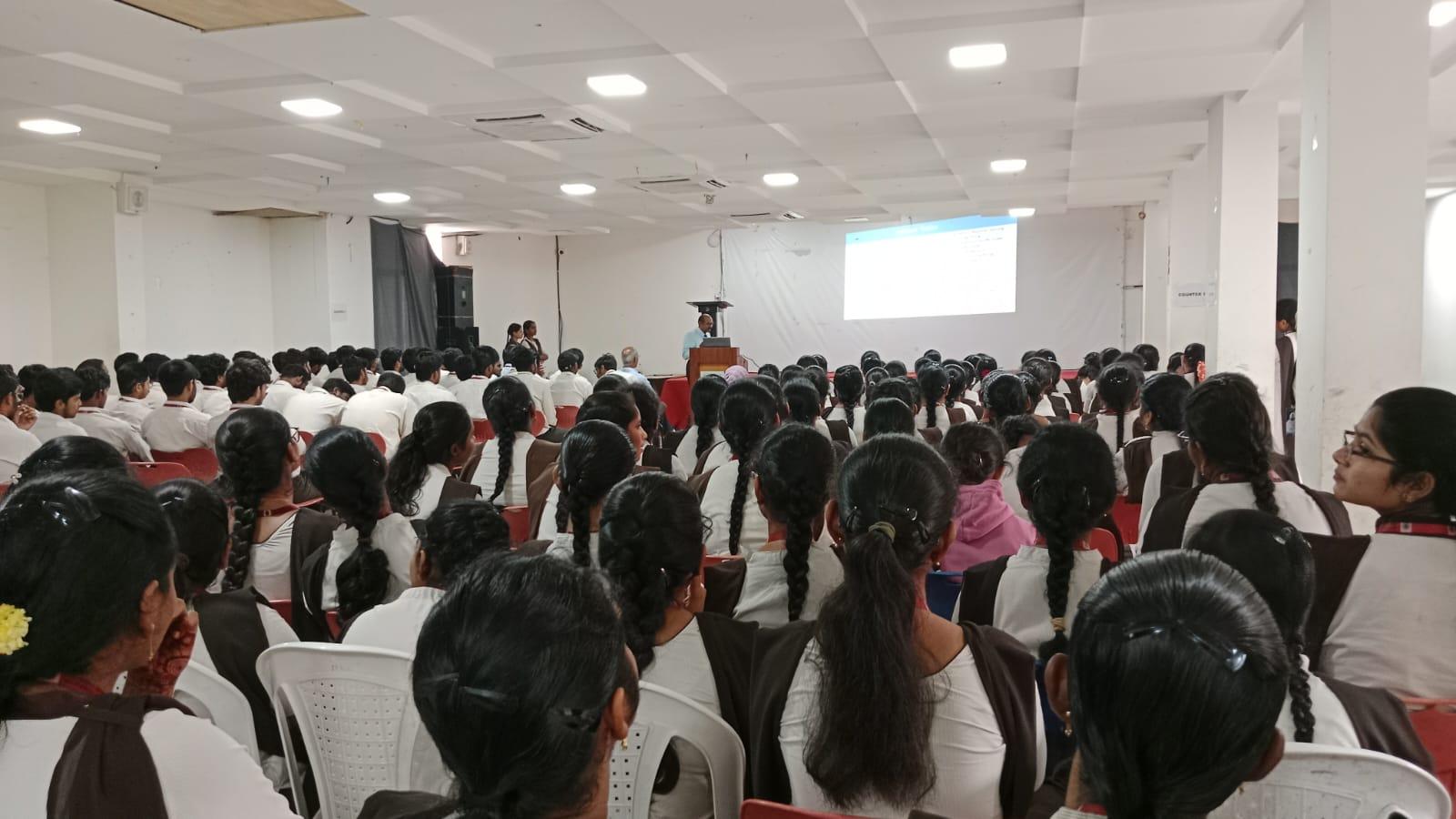
The Association for Computing Machinery (ACM) Student Chapter successfully hosted an insightful Guest Lecture by Dr. M. V. Krishna Rao on Saturday, January 3, 2026. The event, titled "Machine Learning: Fundamentals to Advanced Applications," was designed to provide students with a comprehensive roadmap of the ML landscape. The session was held in the Central Block Seminar Hall, drawing an enthusiastic crowd of 200 students eager to explore the future of intelligent systems. Dignitaries and Opening The event was graced by the presence of key college dignitaries, emphasizing the institution's focus on industry-relevant technical education.
• Dr. G. Sanjay Gandhi
• Dr. P. Nageswara Rao
• Mrs. B. Ramya Asa Latha
• Dr. G. Satyanarayana
• Mrs. S. Narendra
The session commenced with an opening address by Dr. M. V. Krishna Rao, who noted that understanding Machine Learning is no longer optional but a core necessity for modern engineers.
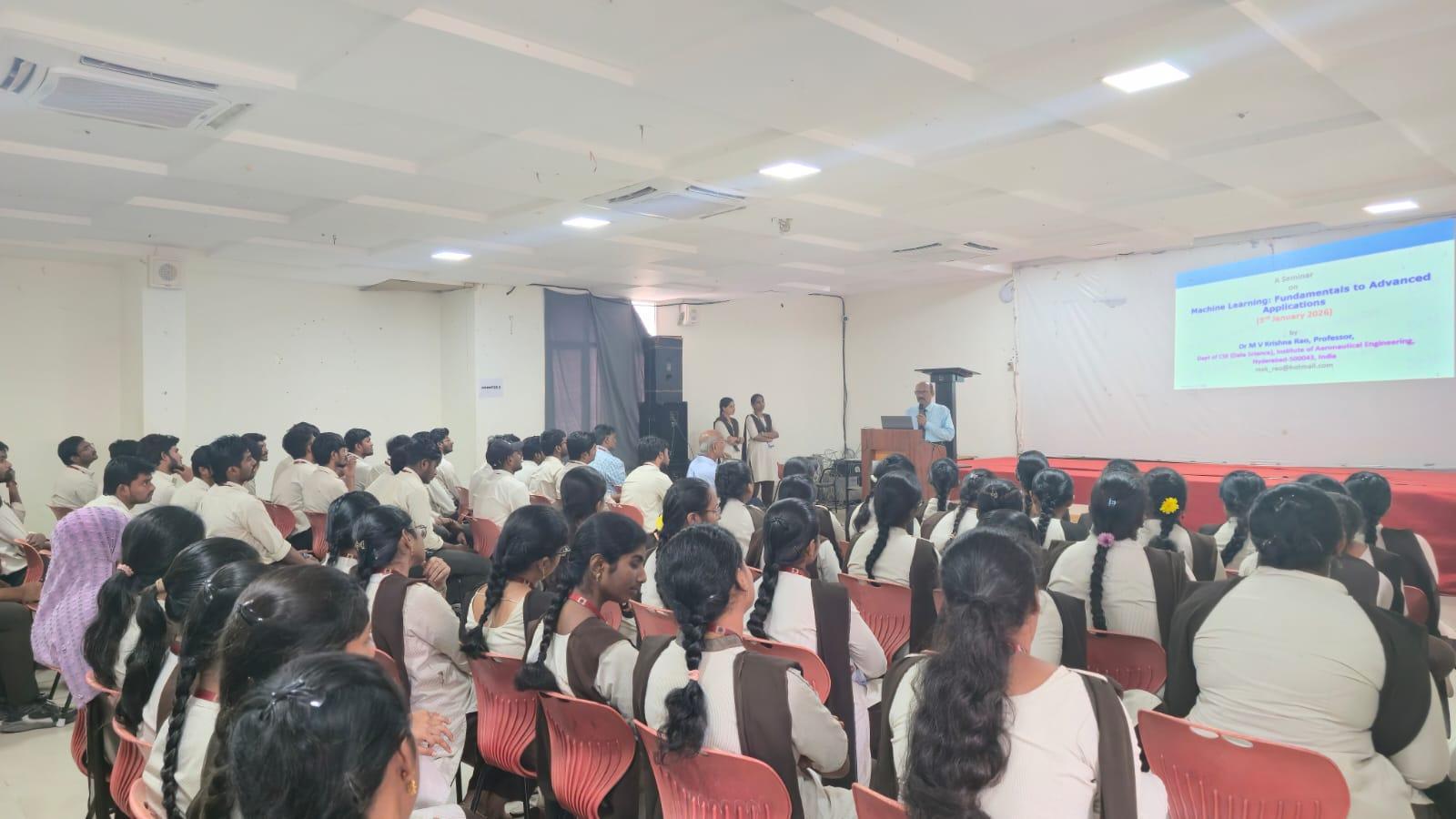
Technical Session Overview
Dr. M. V. Krishna Rao delivered an elaborate presentation, breaking down complex mathematical and computational concepts into digestible insights. The seminar was divided into phases, enabling students to move systematically from foundational concepts to advanced analytical reasoning and model optimization. This phased approach helped students relate theory with practical relevance while building confidence step by step.
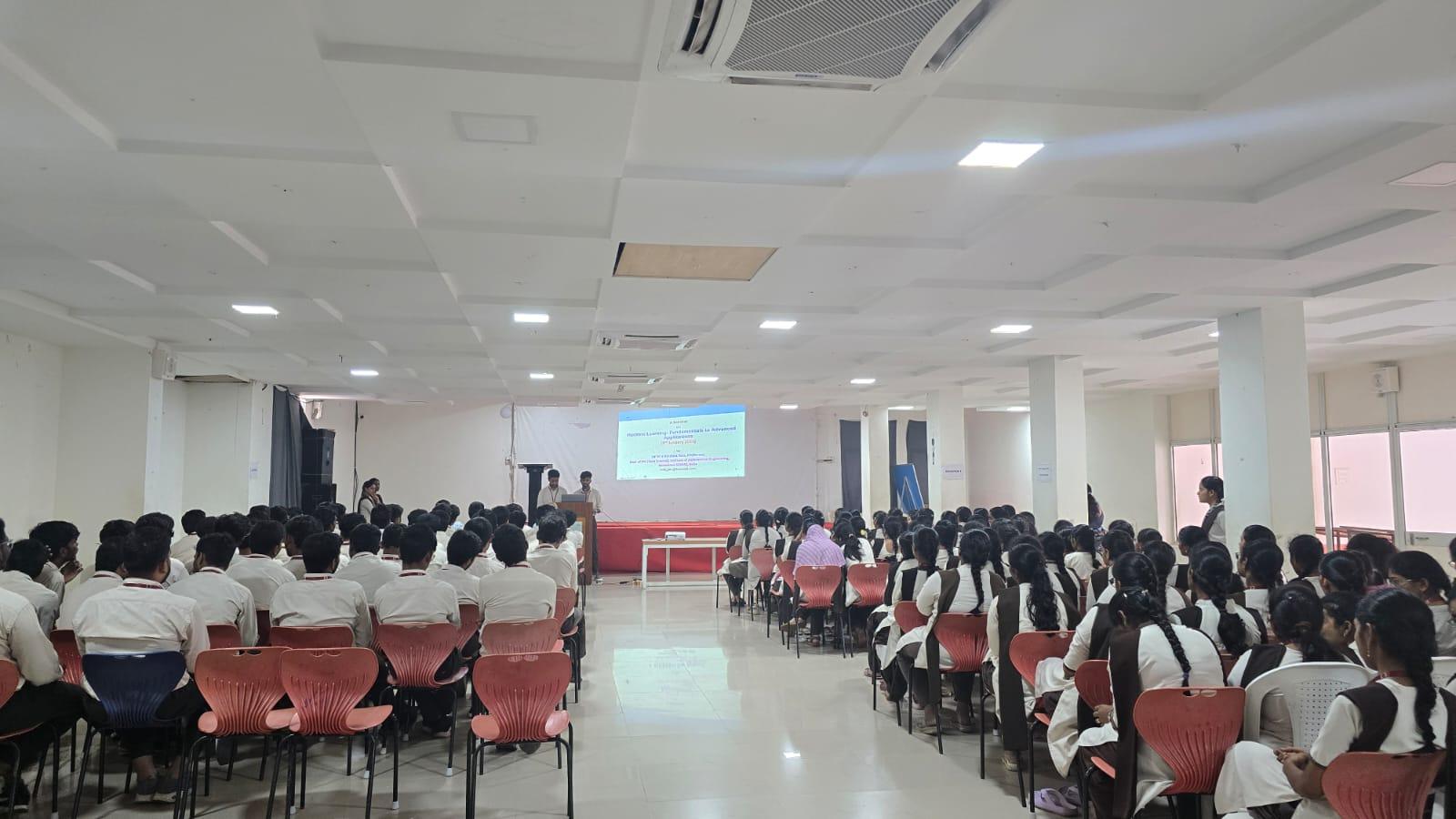
Warm Introduction of Dr. M. V. Krishna Rao by VVITU Students
PHASE I: FOUNDATIONAL CONCEPTS OF DATA AND INTELLIGENCE
Phase Objective
To build a strong conceptual base by understanding data, intelligence, and the need for machine learning in modern computing. 1. Data Fundamentals, Datasets, and Data Models Dr. Rao began the seminar by emphasizing that data is the backbone of machine learning. He explained that without meaningful and high-quality data, intelligent systems cannot be built.
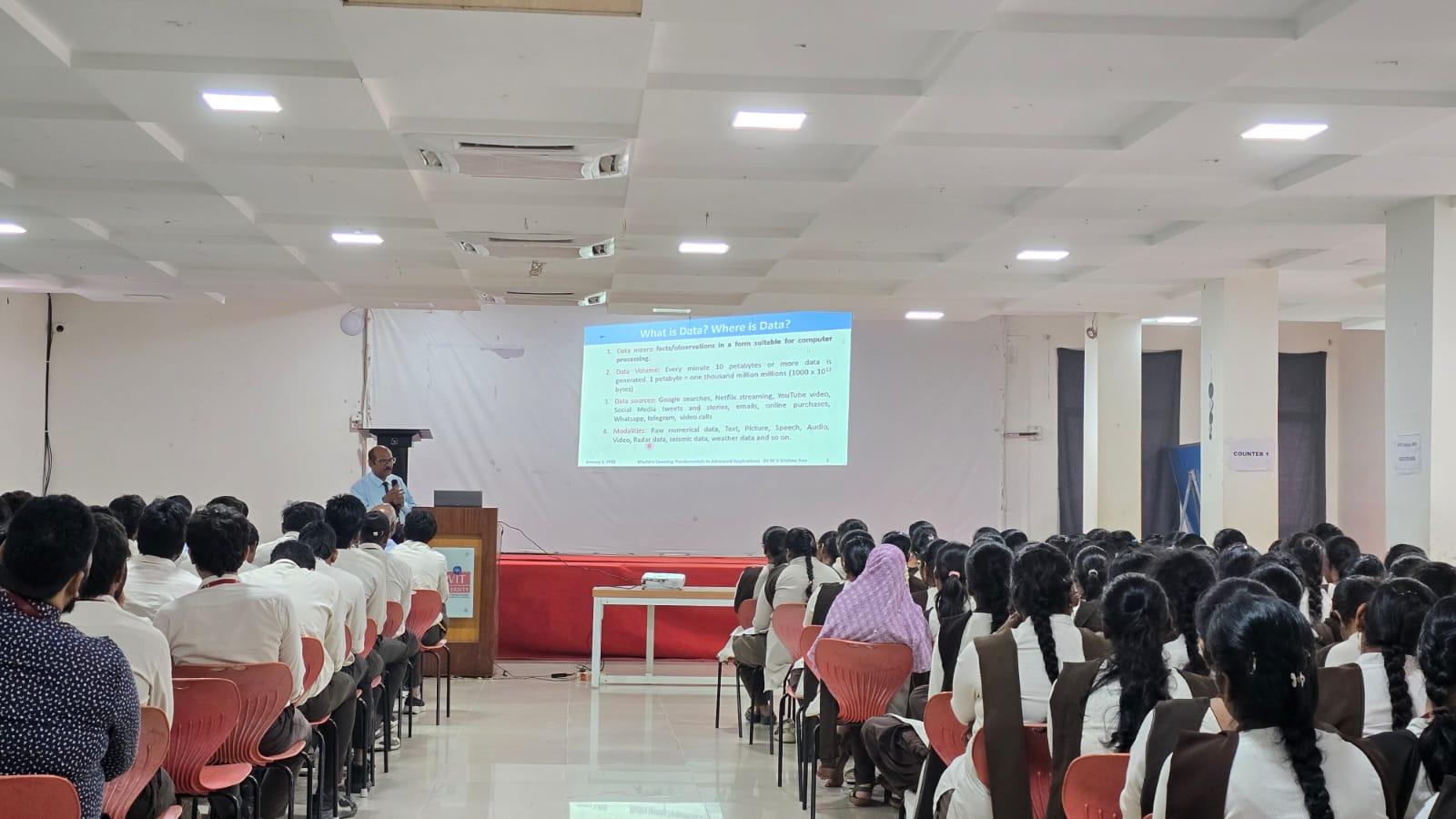
Students actively immersing themselves in the session
Data Fundamentals
• Unstructured Data: Images, audio, video, and free text Datasets Data consists of raw facts collected from real-world sources such as user activity, sensors, transactions, and digital platforms. He explained:
• Structured Data: Tabular data stored in databases and spreadsheets
• Semi-Structured Data: XML, JSON, and system logs
He also introduced the 5 Vs of Data—Volume, Variety, Velocity, Veracity, and Value—highlighting their importance in ML systems. A dataset is a collection of observations used for learning. It consists of:
• Features: Input variables
• Labels: Output variables
Dr. Rao explained dataset partitioning into training, validation, and testing datasets, stressing that proper splitting ensures reliable and unbiased model evaluation.
Data Models
Data models describe how data is logically organized:
• Record-based models
• Graph-based models
• Document-oriented models
2. Human Intelligence vs Machine Intelligence
Dr. Rao compared human intelligence with machine intelligence to clarify misconceptions.
• Human intelligence is emotional, creative, and adaptable.
• Machine intelligence is logical, data-driven, and task-oriented.
He emphasized that machines do not possess consciousness but learn patterns from data to make decisions.
3. What is Machine Learning?
Machine Learning was defined as a field where systems learn from experience rather than explicit programming. Dr. Rao cited Tom Mitchell’s definition and supported it with examples like spam filtering, recommendation engines, and face recognition. He explained how ML systems continuously improve their performance when exposed to more data.
PHASE II: DATA MODELING AND LEARNING PARADIGMS
Phase Objective
To help students understand how real-world problems are converted into mathematical and computational models.
4. Data Modeling in Machine Learning
Data modeling involves translating real-life problems into mathematical forms. Dr. Rao described the process:
1. Data collection
2. Data cleaning and preprocessing
3. Feature extraction and selection
4. Algorithm selection
5. Model training and validation
He highlighted that most ML project failures occur due to poor data preprocessing.
5. Relationship among AI, ML, and Data Science
Dr. Rao explained the hierarchy:
• Artificial Intelligence as the umbrella concept
• Machine Learning as a subset of AI
• Data Science as a multidisciplinary field combining ML, statistics, and domain expertise
This explanation helped students differentiate overlapping terminologies.
6. Applications of Machine Learning
The seminar explored diverse applications:
• Healthcare: Disease prediction and diagnostics
• Finance: Fraud detection and credit scoring
• Education: Personalized learning systems
• Transportation: Autonomous vehicles
• Agriculture: Crop yield prediction
Students were encouraged to think about socially impactful ML applications.
7. Machine Learning Workflow
Dr. Rao presented a standard ML workflow:
1. Data acquisition
2. Data preprocessing
3. Feature engineering
4. Model training
5. Validation
6. Testing
7. Deployment
8. Machine Learning Scenarios
Different learning scenarios were explained:
• Supervised learning
• Unsupervised learning
• Semi-supervised learning
• Reinforcement learning
Each scenario was explained with relatable real-world examples.

PHASE III: MODELING APPROACHES AND LEARNING METHODS
To introduce students to different modeling philosophies used in ML systems.
9. Statistical and Heuristic Models in ML Statistical Models
Dr. Rao explained models based on probability and statistics:
• Linear Regression
• Logistic Regression
• Naive Bayes
Heuristic Models
Heuristic models use rule-based or experience-driven logic:
• Decision Trees
• Rule-based systems
• Evolutionary algorithms
He explained why combining statistical rigor with heuristic reasoning improves performance.
10. Types of Learning Methods
The learning methods were revisited with deeper insights:
• Supervised Learning
• Unsupervised Learning
• Semi-supervised Learning
• Reinforcement Learning
Practical use cases were discussed for each.
PHASE IV: MODEL EVALUATION, ERRORS, AND OPTIMIZATION
Phase Objective
To enable students to analyze model behavior and improve performance.
11. Important Elements in Machine Learning
Key elements discussed:
• Quality of data
• Choice of model
• Learning algorithms
• Loss functions
• Optimization techniques
12. Overfitting and Underfitting
• Overfitting occurs when a model memorizes training data
• Underfitting occurs when a model is too simple
Dr. Rao stressed the importance of balance.
13. Generalization Capacity of an ML Model
Generalization refers to a model’s ability to perform well on unseen data, which Dr. Rao described as the true test of intelligence.
14. Performance Evaluation of ML Models
Evaluation metrics discussed:
• Accuracy
• Precision
• Recall
• F1-score
• Mean Squared Error
Metric selection depends on the application.
15. Bias and Variance in ML Errors
• Bias: Error due to oversimplified assumptions
• Variance: Error due to sensitivity to data
Dr. Rao explained the bias–variance tradeoff.
16. Model Underfitting and Overfitting Analysis
• Underfitting leads to high bias
• Overfitting leads to high variance
Cross-validation was discussed as a solution.
17. Optimum Model Complexity
The seminar concluded with achieving optimal model complexity through:
• Regularization
• Cross-validation
• Pruning techniques
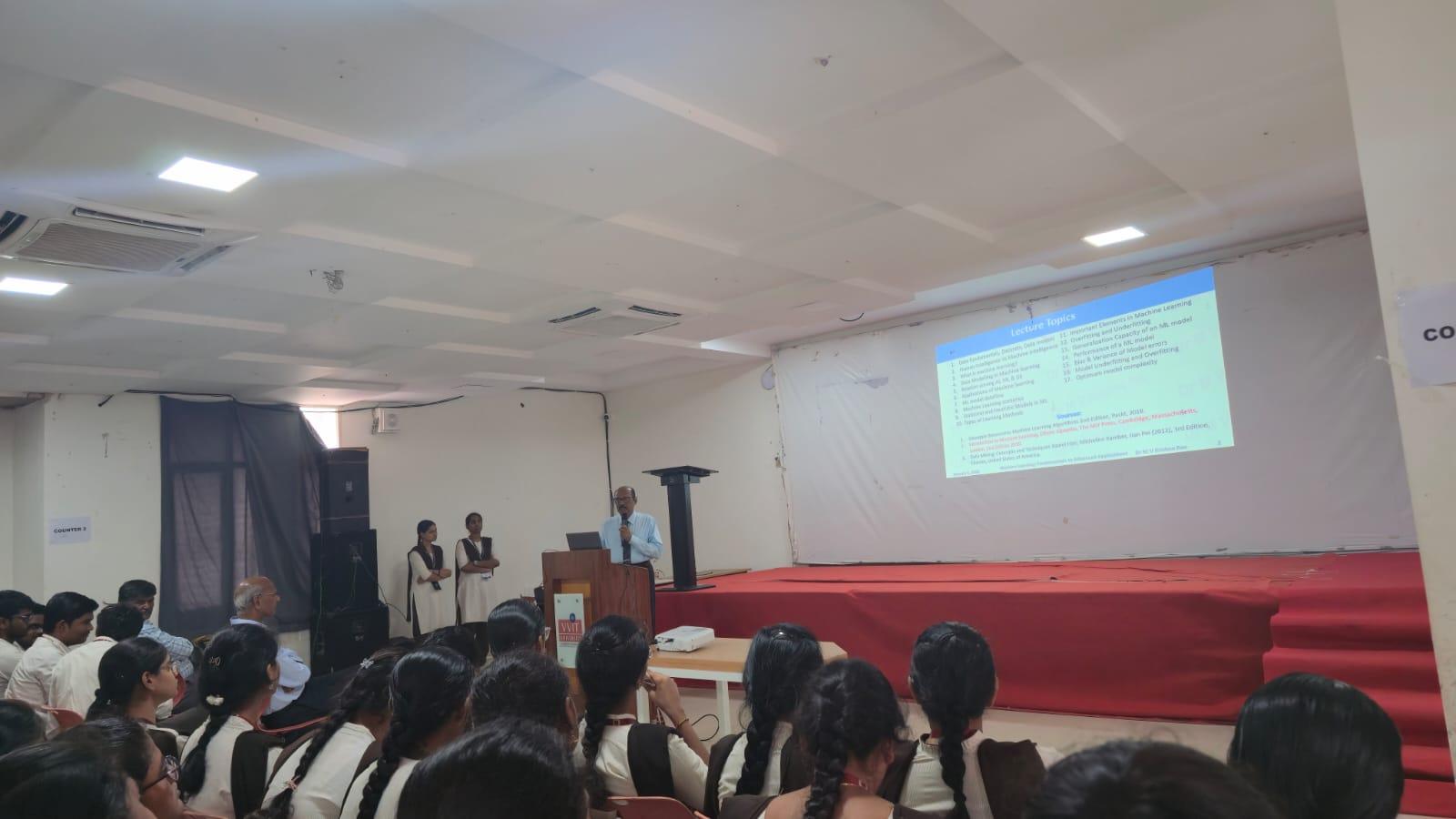
Dr. M. V. Krishna Rao concluding the session with positive vibe
Conclusion
Dr. M. V. Krishna Rao concluded the seminar by motivating VVIT University
students to focus on conceptual clarity, ethical use of AI, and lifelong learning.
He emphasized that machine learning is not just a technology but a problem-solving
mindset. The phase-wise structure enabled students to progress from basics to
advanced reasoning with confidence.